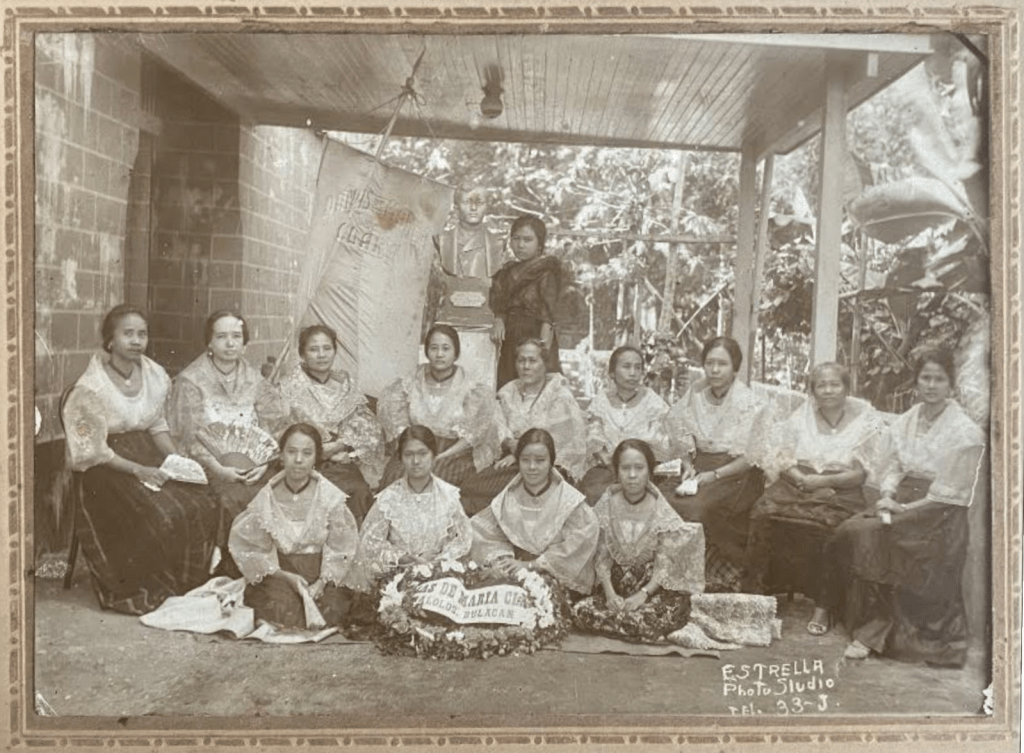
A 1900s photo of Damas de Maria Clara, composed of young women from Malolos, Bulacan, highly likely inspired by the character in Rizal’s Noli Me Tangere / (Jecjec Cruz/Nostalgia Philippines)
Just in time before National Women’s Month 2026 comes to a close, this often overlooked detail in Philippine history deserves renewed attention:
Before Jose Rizal wrote his well-known letter to the Women of Malolos, Graciano Lopez Jaena had already taken notice of their cause and written in their defense.
By the time the young women of Malolos petitioned for education in 1888, Graciano had already been in Spain for nearly a decade, having arrived in 1880 and established himself as a visible voice in Spanish intellectual and political circles. He had spoken before public audiences, written in the press, and consistently argued for Filipino equality and capacity in venues that extended beyond the Filipino community.
It was within this context that he wrote “Amor á España, o A las jóvenes de Malolos” (1889), published in the maiden edition of La Solidaridad, one of the earliest published responses to the young women’s petition. In the article, he praised their boldness and saw in their demand for education a sign that Filipinos “do not wish to be left behind in the march of contemporary progress.”
Del Pilar then called Rizal’s attention to Graciano’s article and suggested that Rizal also write to the women in Tagalog. Rizal complied. His intervention thus came after Graciano’s and illustrated how Rizal had long been watching Graciano’s public career closely, reporting Graciano’s fame to his family, noting how warmly his speeches were received, and even praising one of his lectures as surpassing both their speeches.
As such, Graciano’s article is not simply a tribute. It is an early, public articulation written in Spain of support for Filipina education, grounded in a broader advocacy for equality, reform, and dignity.
Graciano’s article on the young women of Malolos is reproduced in full below (as reproduced in Discursos y Articulos Varios):
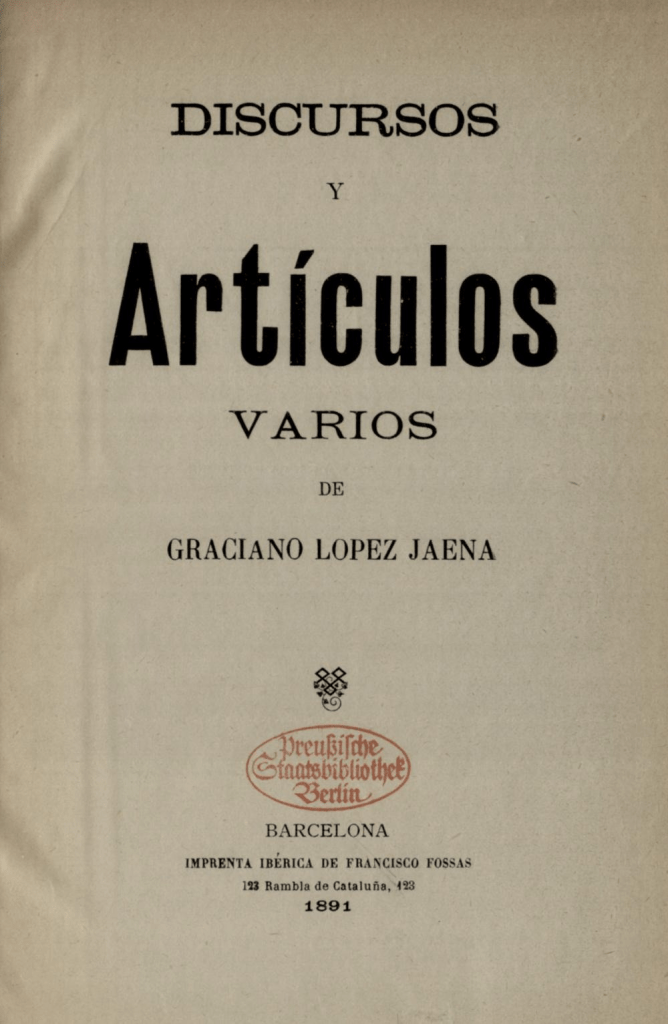
Inside cover of Graciano’s Discursos y Articulos Varios / Staatsbibliothek zu Berlin Digital Collections
“AMOR Á ESPAÑA, O A LAS JÓVENES DE MALOLOS”
Our congratulations to the young women of Malolos.
The latest mail from Manila, arriving on the 7th of this month, has brought us welcome news, among which one item deserves special mention as one of the first and most important — that reported by La Opinión in its January 1st issue:
“According to our sources, it appears that the establishment of a school for learning Castilian in Malolos will soon become a reality, where lessons will be given to women by a teacher who, upon the recommendation of the Provincial Governor, will be appointed by the corresponding authority.
This educational institution, long proposed for this area, will finally be approved by the Higher Authority, at the petition of the unmarried young women of the town, who presented their request to our chief authority during General Weyler’s visit to that town.
The conduct of the women of Malolos is worthy of every praise and, we are certain, this example will soon be followed by other towns.”
This good news fills us with joy, for it shows that the Filipino people do not wish to be left behind in the march of contemporary progress. When even women are demanding education, enlightenment, and instruction — malum signum — it reveals that everything there still remains to be done, and that neglect reigns over the islands.
—
On this matter of night schools for ladies and young women, now favorably resolved by Governor Weyler, La Publicidad in its January 30th issue, in a well-written article titled “La Asociación Hispano-Filipina,” has shed some honest light on the veil of mysterious obstacles this idea had encountered in official circles, stating:
“The Manila press offers us some recent data that we believe merits consideration.
General Weyler, like all generals upon assuming command of the islands, published — upon the recommendation of Mr. Quiroga — a decree urging greater interest in spreading the official language throughout the islands. Praising this measure, the newspaper La Opinión stirred patriotic sentiment to contribute to the teaching of Castilian, suggesting practical ideas toward the fulfillment of this noble purpose.
Later, the same newspaper reported that Messrs. D. Teodoro Sandico and D. Graciano Reyes, teachers of primary and secondary education with academic credentials, but receiving no salary from the public budget, went to the Civil Government of Bulacan to express their desire to act on the Government’s stated intentions. To this end, they requested authorization to open, at no cost to public funds, night schools for adults of both sexes, offering to teach the following program:
1. Practical and intuitive instruction in the Spanish language.
2. Elementary instruction in Castilian grammar.
3. Principles and exercises in arithmetic.
4. Penmanship.
5. Elements of geography.
6. General notions of the history of Spain.
7. Physical education.
The press and all supporters of progress welcomed the patriotism of Messrs. Reyes and Sandico; but today we learn that authorization was denied on the grounds that the school would be nothing less than a threat to the integrity of Spain.
We shall spare our commentary.”
—
To these statements by the writer of La Publicidad, which we fully endorse, one may add a certain offensive reluctance contained in a report to the higher government of the islands — which says that it is not morality, but rather the lesser evil, that will suffer from its approval.
Good causes find justice sooner or later. The noble intentions of the fairer sex of a Bulacan town — to educate and enlighten themselves — have triumphed over Machiavellian intrigues; and Machiavellian they are, indeed miserably so, those schemes forged to impede progress in that Spanish land of the East.
A single petition by women was enough to foil the obstructionist plans that sought to prevent the creation of that school. For it fits squarely within the agenda of the reactionaries that the ignorance of the fairer half of humanity serves as the absolute breeding ground for fanaticism and social degradation — while women’s enlightenment and love of progress engenders advancement and the elevation of peoples.
Thus it is that the status quo parties in the Philippines endeavor, by every means at their disposal, to keep the Filipino woman submerged in the unfathomable depths of ignorance — at times by inflaming her inherently Oriental, and therefore fantastical, imagination with tales and superstitions bordering on manipulation, which find access only in hypnotized and dormant minds; at other times by cultivating and nourishing her heart with unfounded and incomprehensible fears, with servile submission of conscience.
But General Weyler, who never strays from the program of his party — a great patriot and liberal — understanding that the influence of women is the foundation of all society, and that it is not in vain that democracies have flourished in modern times, chose to abide by the reports requested and rendered, and resolved this contentious matter of night schools to the satisfaction of public opinion and of its worthy proponents.
—
We are struck with admiration and cannot cease to praise, admire, and applaud the noble boldness, the admirable bearing, and the determination with which the charming young women of Malolos presented themselves to the Archipelago’s highest authority during his visit to that town — demanding justice in vindication of their honor and loyalty, called into question by a certain report and offended by more or less reticent remarks.
Certainly: in decreeing the establishment of a night school in Malolos in accordance with what the women requested in their petition, the higher authority has done nothing more than fulfill a patriotic duty and translate into action the law — the intention of the metropolitan governments and the sacred mandate of our ancient kings of Aragon and Castile, placed intentionally into oblivion by those who were supposed to carry it out: to teach them Castilian and draw them into common life, to make Spanish in every sense the indigenous peoples, the Indians of the lands conquered by Spain.
For the women of Malolos asked for nothing more than to be taught and immersed in the rudiments of Castilian grammar in those schools, in order to one day speak the harmonious and melodious language of the motherland.
To see anything else in the intentions of the young women of Malolos — other than the noble aspiration to be Spaniards not only in right, but also in fact and in custom, which they are not yet, like the rest of the Filipino people — would be to imagine, like Don Quixote, giants where there are only windmills.
The desires of the fair women of Bulacan deserve not only our applause and enthusiasm, but something more — our wholehearted support. For this and more we are and call ourselves democrats, trusting that the women of other towns will imitate the fine example and the never sufficiently praised conduct of their companions from Malolos.
—
To this end, and as an example to be followed, we shall reproduce the petition that a delegation of twenty young women — with uncommon composure for Filipino youth, but with great respect and dignity — presented to General Weyler during his official visit to the entire province.
It reads as follows:
“Most Excellent Lord Governor-General of the Philippines. — Most Excellent Sir: — We, the undersigned young women, and some others, present ourselves before Your Excellency with due respect to state: that being desirous of learning the rich Spanish language, encouraged and grateful for your generous spirit in spreading the language of Castile throughout the country, and being unable to learn it in the schools of Manila — some due to their modest means, others due to pressing circumstances that keep them at home or occupied with more immediate domestic duties — With this purpose — A. V. E. — we humbly request that we be granted a Night School in the home of an elderly relative, where we shall attend in the company of our mothers to receive lessons in Castilian grammar under the instruction of the professor of Latin who, at our own expense, has in a short time demonstrated his aptitude for teaching Castilian, as evidenced by his students — unlike the town’s schoolmasters who, without meaning to offend them professionally, have so far not achieved positive results.
“This is a favor we do not doubt we deserve, given the recognized goodness of Your Excellency, whose important life may God preserve for many years. — Malolos, December 12, 1888. — Alberta UiTangcoy. — Teresa Tantoco. — Maria Tantoco. — Merced Tiongson. — Agapita Tiongson. — Basilia Tiongson. — Paz Tiongson. — Feliciana Tiongson. — [Signatures follow.]”
—
We are greatly pleased by this determined movement shown by the dalagas of Malolos toward modern education and enlightenment. We do not hesitate to assure that Spain, our common mother, will see these great endeavors to improve the social and political conditions of those towns crowned with success.
Scorning slander, and ever ardent in their desire for progress and enlightenment, the fair women of the Philippines will thus achieve the fulfillment of their patriotic and admirable purposes.
Moreover, one thought we feel compelled to suggest to the charming young women of Malolos: that tomorrow, when they become mothers, they must not forget that their progress is owed to the motherland, and that their duty as Spanish women and mothers imposes upon them the sacred obligation of instilling in the tender hearts of their children an undying love for Spain.
—
 Peripheral Visions
Leave a comment