Originally published on Facebook on December 17, 2024
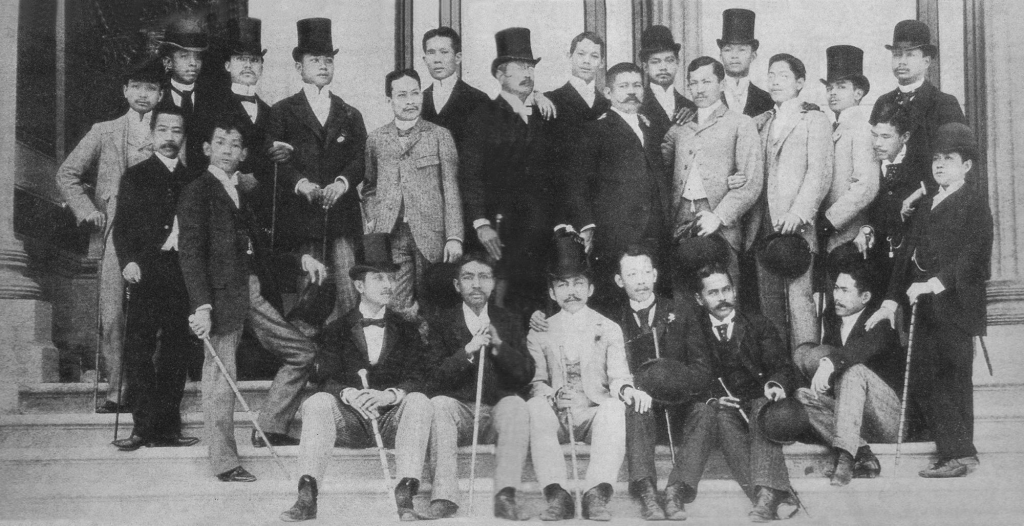
Photo of the Filipino “Ilustrados” taken in Madrid around 1890. Most publications name the personalities in the photo as follows: (Standing from left) Vicente Francisco, Cajigas, José Abreu, Mariano Abella, Dominador Gómez, Francisco T. Liongson, Flaviano Cordecruz, a Tuazon from Malabon, Alejandro Yance de Lara, Lauro Dimayuga, Marcelo H. del Pilar, Gregorio Aguilera, José Rizal, José Alejandrino, Baldomero Roxas, Moises Salvador, Modesto Reyes, Gaudencio Juanengo, Pablo Rianzares Bautista; Seated from left: Dr. Santamaria, Candido Morada, Damaso Ponce, Ariston Bautista, Pedro Serrano Lactao, and Teodoro Sandico. Based on recently discovered photographs, we have reason to believe that the person identified as Sandico is actually Graciano Lopez Jaena. Photo from https://upload(dot)wikimedia(dot)org/wikipedia/commons/7/74/Ilustrados_1890.jpg
Tomorrow, December 18, Iloilo will celebrate Graciano Lopez Jaena Day. Unfortunately, efforts to preserve Graciano’s legacy remain insufficient, and there is even an ongoing attempt to diminish his significance in Philippine history [1]. But recent advancements in technology and artificial intelligence have significantly enhanced the storage, digitization, analysis and interpretation of historical documents over the past several years. These developments have enabled large-scale digitization, automated text recognition (OCR), and data analysis of archival records, allowing scholars not only to access previously inaccessible documents but also to conduct more comprehensive surveys of historical records. As a result, these tools have deepened our understanding of historical events, trends, and narratives, offering fresh insights into the complexities of the past, including the life and legacy of Graciano Lopez Jaena.
Some of the institutions that have published their archival data (relating to the Philippines) include the Biblioteca Nacional de España (BNE), the Portal de Archivos Españoles (PARES), the University of Santo Tomas Miguel de Benavides Library and Archives, and the Family Search website of the Church of Jesus Christ of Latter-day Saints (LDS). Among these, Family Search arguably holds the richest records in terms of previously unsorted and unindexed information. The LDS has partnered with institutions such as the Roman Catholic Church, particularly the many Philippine dioceses and archdioceses, and the National Historical Archives to scan, digitize, and store copies of their records, literally from birth to death. More recently, these records have been hosted and made accessible on the Family Search website. This is particularly valuable to Philippine researchers, who often face bureaucratic hurdles in accessing historical records in local museums, archives, and libraries. Just this December, Family Search added over 19 million new archival records from the Philippines to its database!
Because we are now able to access these records, we now know the following information about Graciano Lopez Jaena:
Before leaving for Spain in 1880, Graciano’s name appeared as Graciano Lopes (not Lopez) in several records of the Roman Catholic Archdiocese of Jaro. These records document his role as a godparent or witness to baptisms, reflecting the strong ties he had with families in Ciudad de Jaro.
On November 25, 1877, Graciano stood as godfather to Filemon Buyco, the second child of Raymundo Buyco and Martina Homisillada. On March 16, 1878, he served as a witness for the baptism of Patricia Gueloresa, daughter of Lorenzo Gueloresa and Genoviva Celis. Shortly after, on April 6, 1878, he was also the godfather to Ancelmo Mejares, the firstborn of Vicente Mejares and Barbara Jornales.
Graciano’s involvement continued as a witness at the baptism of Filimon Fernandes on March 15, 1879, the second child of Ximiano Fernandes and Juana Hechanova. Finally, on February 14, 1880, he appeared again as a witness for Severino Mejares, the fifth child of Vicente Mejares and Barbara Jornales.
The parents of these children, along with other witnesses like Juan Jimeneo, Edilberto Goles, Vicente Lopes, Ysidro Miranda, and Alejandro Velaso, were Graciano’s compadres and comadres — fellow members of the tightly knit Jaro community who knew him during his early life. These records not only underscore his active participation in local religious and social events but also serve as a testament to the relationships he left behind when he departed for Spain. His records show he left for Spain in March 25, 1880.
The Family Search website also reveals several curious discoveries, one of which is a baptismal record for a different Graciano Lopes. This Graciano was born on January 1, 1852, and baptized two days later, on January 3, with Jose Alonso Comendador officiating the ceremony. His parents were Placido Lopes and Jacube (or Jacobe) Jaena, and his godfather was Ermogenes Jabellana. It is likely that this Graciano was an earlier child of Placido and Jacobe who did not survive infancy [2]. Oscar Lopez [3][4] recounts a similar instance within the second generation of the Lopez family, where Claudio Lopez appeared in two separate baptismal records. According to Lopez, the older Claudio must have died young, and his parents, following common practice, gave the same name to the next male child. It is not improbable, therefore, that the Graciano baptized in 1852 also died young, leading to a younger brother being named Graciano in his memory.
Another curious entry from FamilySearch appears in the baptismal registry of Tayabas (now Quezon) and is dated December 20, 1888. It records the baptism of a Graciano Lopez, described as the legitimate son of Placido Lopez and Margarita Nada. Although it seems unlikely that this record of “Graciano and Placido” has any connection to Graciano Lopez Jaena of Iloilo, a separate baptismal record tied to Graciano Lopez Jaena’s family provides further insight. This record states that on December 21, 1892, a child was baptized Graciano Ramon Lopez by Tomas Palmos, just four days after his birth on December 17, 1892. The parents of the child were Domingo Lopez, (Graciano Lopez Jaena’s brother) and Julia Barroso.
These findings raise a significant question: if Graciano Lopes, the son of Placido Lopes and Jacobe Jaena, was baptized on December 20, 1856, three days after his birth, when was he actually born? The question becomes more complex when considering that several historians, most notably Demy Sonza, argue for December 18 as Graciano Lopez Jaena’s birthday. Sonza bases this claim on “the custom of the day” and the Roman Catholic almanac, which lists San Graciano [5] as one of the patron saints celebrated on December 18. However, many baptismal records from the 1800s reveal that a significant number of male children named Graciano were baptized on December 20. This pattern may still be linked to the Feast Day of Saint Gatianus [6]: while December 18 marks the formal celebration of the saint, it is traditionally believed that Saint Gatianus died on December 20, a detail that may explain the prevalence of December 20 baptisms for children bearing the name Graciano. We have reason to question if, indeed, Graciano’s birthday falls on December 18 and not on December 17.
While many questions remain unanswered and new ones continue to emerge, history—and the people who shaped it—has become more accessible and tangible than ever before. Thanks to technology, we are now closer to the past than we ever used to be.
[1] For example, a number of writers including National Artists Nick Joaquin and Resil Mojares, as well as historian Ambeth Ocampo, believe that Lopez Jaena ought to be replaced by Mariano Ponce from the “Philippine triumvirate” whose other members are Jose Rizal and Marcelo del Pilar.
[2] We therefore update Graciano Lopez Jaena’s siblings as thus: Graciano (b.1851); Graciano (b.1856); Pedro (b.1859); Ramon (b.1861); Candelaria (b.1864); Domingo (b.1865); and Doroteo (b. 1867).
[3] Lopez, Oscar M., ed. The Lopez Family: Its Origins and Genealogy, Being Chiefly an Account of the Eight Main Lines and Seven Generations of Lopezes. Vol. 1. Manila: Eugenio López Foundation, 1982.
[4] Oscar Lopez belongs to another Lopez clan who traces their roots to Basilio Lopez and Sabina Jaranilla. While records currently do not support a link between Basilio’s and Placido’s families, Oscar raised the possibility of a familial connection stemming from an illegitimate relationship. This will either be confirmed or debunked as more archival records become more publicly accessible.
[5] Also known as Cassien, Catianus, Gatian, Gratian, Gratianus, and Gratien, was a prominent figure in the early Christian history of Tours, France.
[6] Saint Gatianus of Tours. Catholic Saint | Saint for a Minute: Saints & Blesseds. 2024. https://www(dot)saintforaminute(dot)com/saints/saint_gatianus_of_tours
 Peripheral Visions
wikimedia(dot)org/wikipedia/commons/7/74/Ilustrados_1890.jpg)
Leave a comment