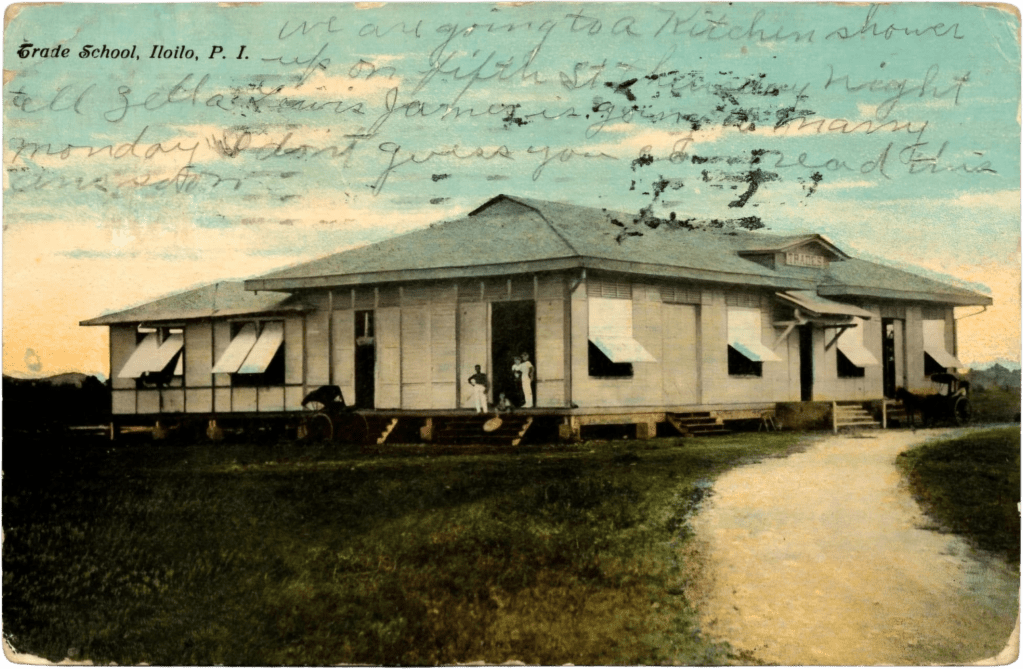
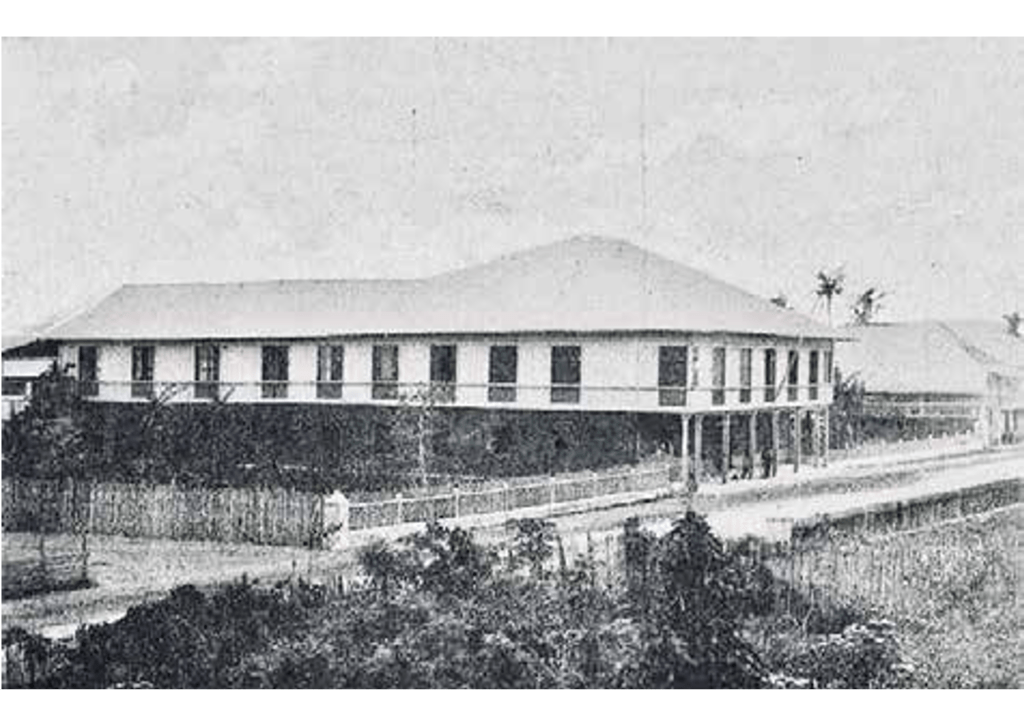
Escuela de Artes y Oficios as photographed by Felix Laureano in 1897. Published in Ilustracion Artistica No. 795, 22 March 1897.
On May 9, 1890, a Royal Decree was issued creating the Escuela Práctica Profesional de Artes y Oficios (Practical and Professional School of Arts and Trades), in Iloilo [1]. The decree came eight years after Graciano wrote his article proposing the establishment of a government-sponsored trade school in the Philippines. [2] In 1882, Graciano was already making a public case for an arts and trade school through the Revista del Círculo Hispano-Filipino. In his article “La Enseñanza Industrial y Artística en Filipinas,” he responded to discussions in Madrid about the neglect of technical education and turned the issue toward the Philippines. He pointed out that a former Governor-General had once planned to establish a center of practical education in Manila, to be extended to the provinces, but that the plan failed to materialize. He also noted that a later proposal to create a school of arts and trades in Manila had collapsed due to lack of funds. Against this pattern of neglect, Graciano argued that the government itself had to take the initiative. He insisted that the Philippines had a “clear and urgent need” for such institutions if it was to keep pace with neighboring colonies in agriculture, industry, and commerce. He also argued that if there was any country in the Far East where schools of arts and trades could produce brilliant results, it would be the Philippines.
For Graciano, the issue was not simply one of education but of capacity. Filipinos possessed talent in engraving, sculpture, drawing, and design. What they lacked was not ability but access to formal education that could cultivate and further develop that ability. He cited the achievements of Filipino artists who had studied in Madrid, including Juan Luna, Melecio Figueroa, Miguel Zaragoza, Félix Resurrección, and Esteban Villanueva. Their success, he argued, proved that the absence of great artists in the Philippines was not due to any lack of native genius, but to the scarcity of educational opportunities. The government, he wrote, had the power to awaken the greatness of a people through education across the trades and crafts. Unlike Gregorio Sanciangco in El Progreso de Filipinas, who acknowledged the need to improve education in the Philippines, Graciano went further by recognizing education not only as a means of advancement but as a force of emancipation.
Graciano further developed this argument in “Una Protesta,” published in Los Dos Mundos in 1883. In the article, Graciano rejected the lazy colonial accusation that the indio was backward by nature. Instead, he turned the blame toward the government itself and toward the deliberate maintenance of ignorance as a political condition. Graciano argued that when people are kept ignorant, they are unable to reflect and to recognize the injustices of government. From that ignorance come misery, superstition, fanaticism, and what he called the indolence of the people. The real problem, in his view, was not the people’s lack of capacity, but a colonial order that had every interest in keeping them powerless. [3]
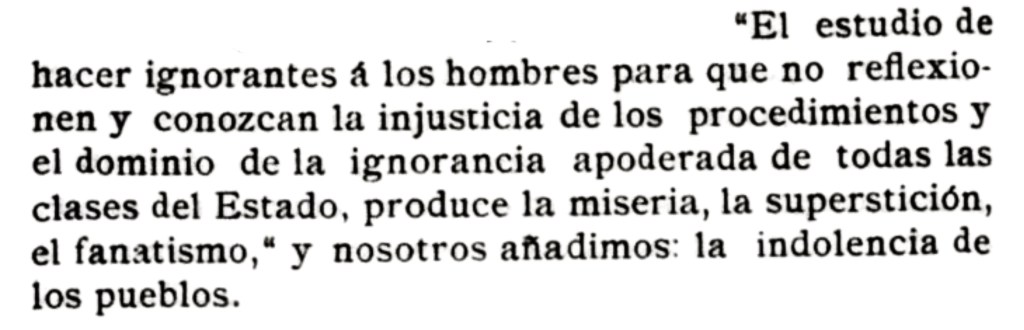
An excerpt from Graciano’s ‘Una Protesta‘, published in Los Dos Mundos: “The effort to keep people ignorant so they do not reflect upon or recognize the injustice of the systems and the dominance of ignorance across all levels of the State, produces misery, superstition, and fanaticism,” and we add: the indolence of the people.
In this context, it can be understood that the Escuela Práctica was not established due to the benevolence of the colonizers, nor should it be considered an administrative gift from Spain. Graciano’s proposal almost a decade earlier had linked education to the larger question of the country’s progress and capacity, and the Spanish government must have realized the truth, albeit a little too slowly, in the proposal. The school therefore was a very important part of the struggle—for education and empowerment, over whether Filipinos would remain confined to ignorance or be equipped with the knowledge and skills necessary to think, create, and rise.
In this light, the history of the Iloilo School of Arts & Trades (today the Iloilo Science and Technology University), must also be narrated more carefully. The re-establishment of the Iloilo School of Arts and Trades should not be told as though it emerged from nowhere, and certainly not as though vocational education in Iloilo began only with the Americans. Its roots lay in an earlier Spanish-period reform discourse in which Graciano was a forceful participant. His writings helped articulate the need, justify the policy, and imagine the kind of industrial future the Philippines might achieve. To acknowledge only the American establishment is to obscure the agency of Filipinos, particularly of Graciano, who insisted that Filipinos must be armed with knowledge, skill, and intellectual discipline in order to counter colonial abuses and overcome the conditions deliberately imposed upon them.
Learn more about Graciano López Jaena. Find out the many long ignored things he did for the Philippines. Read more from the new book Graciano’s Dirty Fingers available in select stores nationwide. Also available online at https://forms.gle/u8iMXNy81DhW2Qw36
[1] Diario de Manila, 6 July 1891; Also referred to as Escuela de Artes y Oficios de Iloilo. The school was established with the aim of promoting and developing training for foremen and workshop masters, as well as artisans, providing especially the latter with the necessary facilities to practice a trade that would contribute to industrial growth and the well-being of the country’s inhabitants. Miguel Rodríguez Berriz, Diccionario de la administración de Filipinas: Anuario de 1892 (Manila: Establecimiento Tipográfico de J. Marty, 1893).
[2] Graciano Lopez Jaena, “La Enseñanza Industrial y Artística en Filipinas,” reprinted in Discursos y Artículos Varios, 1892. It carries the title “The Teaching of Arts and Trades in the Philippines” in the 1971 Corazon Alzona translation, Speeches, Articles, & Letters.
[3] Graciano Lopez Jaena, “Una Protesta,” reprinted in Discursos y Artículos Varios, 1892. “A Protest” in Alzona (trans.), Speeches, Articles, & Letters.
 Peripheral Visions
Leave a comment