Today, we celebrate the proclamation of Philippine independence in 1898 in Kawit, Cavite. That declaration gave birth to a republic, and with it, the question of where power would reside in that republic. Article II, Section 1 of the 1987 Constitution states that “sovereignty resides in the people.”
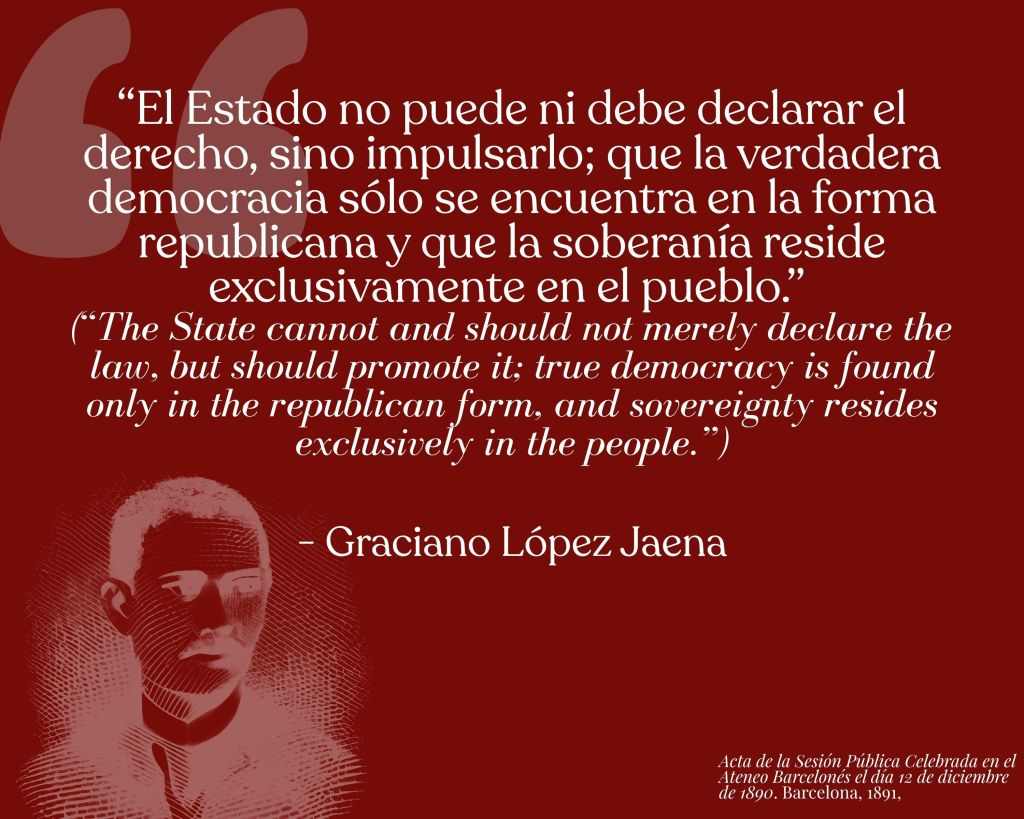
This is an echo of the same principle forwarded in the 1899 Malolos Constitution, the founding charter of the First Philippine Republic. This idea of sovereignty had been seeded earlier. On 26 March 1891, Graciano López Jaena again stood before the Ateneo Barcelonés (where in February 1889 he delivered his famous lecture on the Philippine Exposition) and declared that “sovereignty resides exclusively in the people.” He was directly responding to another speaker’s argument that political authority came from God and was embodied in the State, not derived from the people.
The timing was crucial. Within a few weeks, Graciano sailed for the Philippines. There, in Tondo, he met with members of the Comité de Propaganda, the network founded by Del Pilar that raised funds, circulated democratic ideas, and linked Manila patriots to the movement in Spain. Some of the men in the group would later move into the Katipunan; others would help shape the revolutionary government that produced the Malolos Constitution. When Article 3 of the 1899 Malolos Constitution declared that “sovereignty resides exclusively in the people,” it was not a phrase made in a vacuum. It carried an idea Graciano had already spoken publicly, in almost exactly the same words, before a Spanish intellectual audience in Barcelona.
Read more about Graciano’s previously undocumented accomplishments and contributions in Graciano’s Dirty Fingers still available here.


Leave a Reply