FamilySearch has just announced that it has added 102 million new records from 22 countries, including more than one million civil and church records from Belgium and the Philippines.
For researchers, historians, genealogists, and the curious, this is more than a database update. It is a reminder of how profoundly historical research has changed in just a few years. With the integration of AI in the website’s interface, it’s practically a game-changer for those who know how to use the technology properly.
In the writing of Graciano’s Dirty Fingers, FamilySearch proved to be among the most useful sources of primary information. From baptismal records and civil registries to notarial records, it allowed me to check what would otherwise have been difficult, some almost impossible, to access.
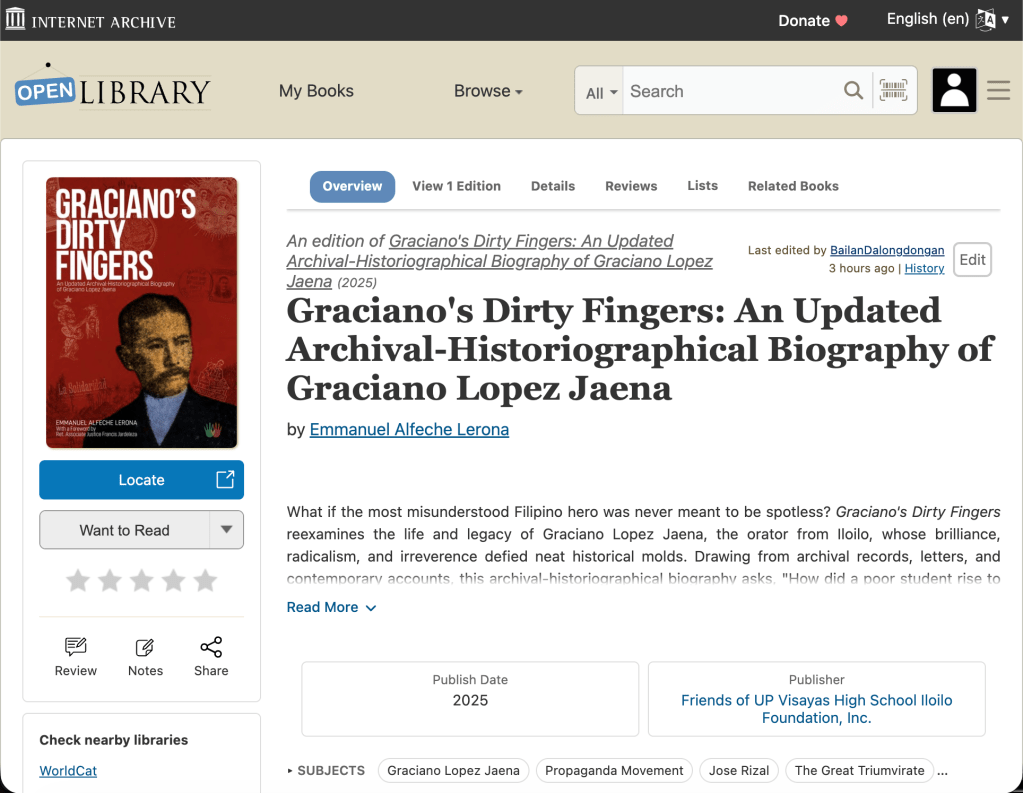
But FamilySearch is only part of a much larger transformation quietly taking place in historical research. The large-scale digitization and online publication of archives have begun to collapse what once made research prohibitively difficult. What previously required expensive travel, bureaucracy, and access to restricted collections can now, in many cases, be searched from a laptop.
Because of this, please allow me to share some of the digital archives and repositories that proved invaluable in my own research, many of which researchers may not yet be fully aware of. The list is in no way comprehensive and represents only the very materials I used in my research:
Archivo Histórico Nacional — [https://pares.cultura.gob.es](https://pares.cultura.gob.es)
Arxiu de Revistes Catalanes Antigues (ARCA) — [https://arca.bnc.cat](https://arca.bnc.cat)
Arxiu Històric de la Ciutat de Barcelona — [https://ajuntament.barcelona.cat/arxiumunicipal/arxiuhistoric/en](https://ajuntament.barcelona.cat/arxiumunicipal/arxiuhistoric/en)
Biblioteca de Catalunya — [https://www.bnc.cat](https://www.bnc.cat)
Biblioteca Digital de la Comunidad de Madrid — [https://bibliotecavirtualmadrid.comunidad.madrid](https://bibliotecavirtualmadrid.comunidad.madrid)
Biblioteca Nacional de España (Biblioteca Digital Hispánica) — [https://bdh-rd.bne.es](https://bdh-rd.bne.es)
Biblioteca Nacional de España (Hemeroteca Digital) — [https://hemerotecadigital.bne.es](https://hemerotecadigital.bne.es)
Biblioteques Municipals de Reus — [https://biblioteques.reus.cat](https://biblioteques.reus.cat)
Diputació de Barcelona — [https://www.diba.cat](https://www.diba.cat)
Europeana — [https://www.europeana.eu](https://www.europeana.eu)
FamilySearch — [https://www.familysearch.org](https://www.familysearch.org)
Global Press Archive — [https://gpa.eastview.com](https://gpa.eastview.com)
Google Books — [https://books.google.com](https://books.google.com)
HathiTrust Digital Library — [https://www.hathitrust.org](https://www.hathitrust.org)
Internet Archive — [https://archive.org](https://archive.org)
Library of Congress Digital Collections — [https://www.loc.gov/collections](https://www.loc.gov/collections)
Memòria Digital de Catalunya (MDC) — [https://mdc.csuc.cat](https://mdc.csuc.cat)
Portal de Archivos Españoles (PARES) — [https://pares.cultura.gob.es](https://pares.cultura.gob.es)
Prensa Histórica — [https://prensahistorica.mcu.es](https://prensahistorica.mcu.es)
Provincial Historical Archive of Salamanca — [https://cultura.castillayleon.es](https://cultura.castillayleon.es)
Staatsbibliothek zu Berlin Digital Collections — [http://resolver.staatsbibliothek-berlin.de/SBB000013D500000000](http://resolver.staatsbibliothek-berlin.de/SBB000013D500000000)
Tarragona Public Library — [https://bibliotecatarragona.cultura.gencat.cat](https://bibliotecatarragona.cultura.gencat.cat)
Universitat de València Historical Archive — [https://www.uv.es/uvweb/college/en/university-archives-1285845048380.html](https://www.uv.es/uvweb/college/en/university-archives-1285845048380.html)
USC Digital Library — [https://digitallibrary.usc.edu](https://digitallibrary.usc.edu)
Wikimedia Commons — [https://commons.wikimedia.org](https://commons.wikimedia.org)
But digital archives, as powerful and potent as they can be, can also intimidate users. They become meaningful and useful only when we learn how to search them carefully.
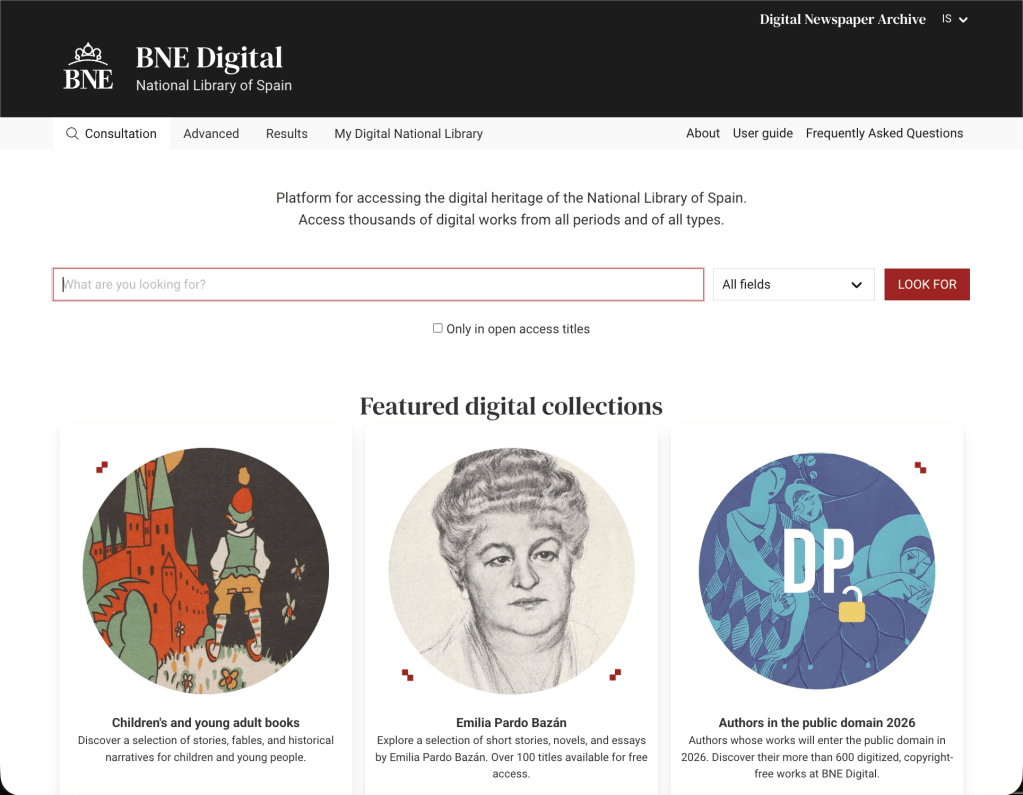
This means learning the basics of Boolean search. Quotation marks, AND, OR, NOT, and parentheses may seem technical at first, but they can dramatically improve search results. A search for “Graciano Lopez Jaena” (enclosed in quotation marks) will behave differently from a general search for the same three words.
It also means learning to search around errors. OCR is imperfect, especially with nineteenth-century newspapers, old typography, faded pages, and inconsistent spelling. A name may appear as *López* or *Lopez*, *Jaena* or *Jáena*, *Filipinas* or *Philipinas*. Sometimes the most important result appears only when we search for an imperfect spelling produced by the machine itself.
Researchers also need to search in the language of the archive. Filipino subjects may be catalogued in Spanish, Catalan, German, French, or other languages depending on where the record was preserved. Searching only in English, or only in Filipino, can leave entire collections invisible.
It also helps to search beyond names. Institutions, events, associations, and places often leave stronger documentary traces than individuals. “Ateneo Barcelonés,” “Congreso Geográfico Colonial,” “Exposición Filipina,” or “Unión Ibero-Americana” may yield more useful results than a personal name alone.
Searching newspapers are especially important. Before records were published in books, they first appeared as announcements, speeches, meeting notices, travel records, illness updates, obituaries, controversies, and passing remarks in the press. In many cases, newspapers preserve the first public trace of an event.
Date filters should also be used aggressively. Restricting a search to a single year, or even to a specific month, can bring forward materials otherwise buried in large databases.
And, of course, footnotes and citations remain essential, but they must always be verified. Historical claims are often repeated across generations without returning to the original source.
Finally, the curious researcher must think transnationally. A Filipino story may leave traces not only in Manila, but also in Barcelona, Madrid, Hong Kong, Berlin, London, Paris, Washington, even Mexico or Cuba, or elsewhere. The archive of Philippine history is not confined to the Philippines.
While some of our records may have been lost to history, there are still millions out there making their way into the digital world. These records are simply waiting to be searched properly. Another case of thanks to technology, we are now closer to the past than we ever used to be.
 Peripheral Visions
Leave a comment